
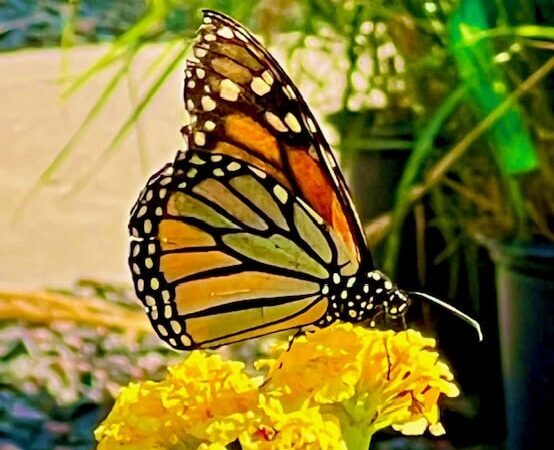
It’s always exciting to see pollinators in our gardens, but the monarch butterfly seems to hold a special place in our hearts. The Colorado Front Range is the eastern boundary for the adult monarch’s migratory path from southern Canada to central Mexico. Monarchs can be seen along the Front Range between June (heading north) and September (heading back south). How can we attract those boundary travelling monarchs to our garden?
MiIkweed for Monarch Butterflies
When talking about monarchs, the conversation can tend to revolve around milkweed. Adult female monarchs only lay their eggs on milkweed, and the hatched monarch larvae only feed on milkweed. The two native milkweed species in Colorado are Showy Milkweed (Asclepias speciosa) and Spider Milkweed (Asclepias asperula). Any Asclepias species of milkweed will suffice as a larval monarch food source. What about the adults?
Think Beyond Milkweed
Adult monarchs do not survive exclusively off milkweed. Therefore, we need to think beyond milkweed to attract the monarchs to our personal gardens. Adult monarchs are looking for suitable food, shelter and water in close proximity to the milkweed during their migratory journey.
Flowers for Monarch Feeding
For food, adult monarchs need a continuous supply of nectar from June through September. Butterflies feed through their straw-shaped proboscis. Therefore, tubular shaped flowers (ie Liatris, Dalea purpurea, Mondarda) are ideal. If not tubular, butterflies will look for a flower with a large landing pad to sip nectar (ie Echinacea, Gaillardia, Coreopsis). Make sure something is always blooming in your garden so there’s a continuous food source. Desirable annuals may be supplemented as perennial plantings can be difficult to time. Appropriate annuals would be Zinnia and Ageratum.
Shelter for Monarchs
For shelter, the location of your garden is important to monarchs. Butterflies prefer a sunny, airy location protected from wind. Regular deadheading and pruning will help keep good air circulation. Plants should be in groups versus single plants here and there. In close proximity to the nectar sources, Monarchs would appreciate shrubs or small trees for additional shelter and large rocks for sunning.
Water for Monarchs
For water, butterflies obtain liquids from nectars and rotting plants and animals. Butterflies are also known to puddle. Puddling involves drinking water from mud puddles where they get salt and minerals. You can leave a patch of dirt unplanted and regularly watered or put out a shallow bowl with water, mud and a pinch of salt.
While milkweed is necessary, the whole habitat needs to be taken into consideration in order to give yourself the best chance of attracting the monarch to your garden.
