
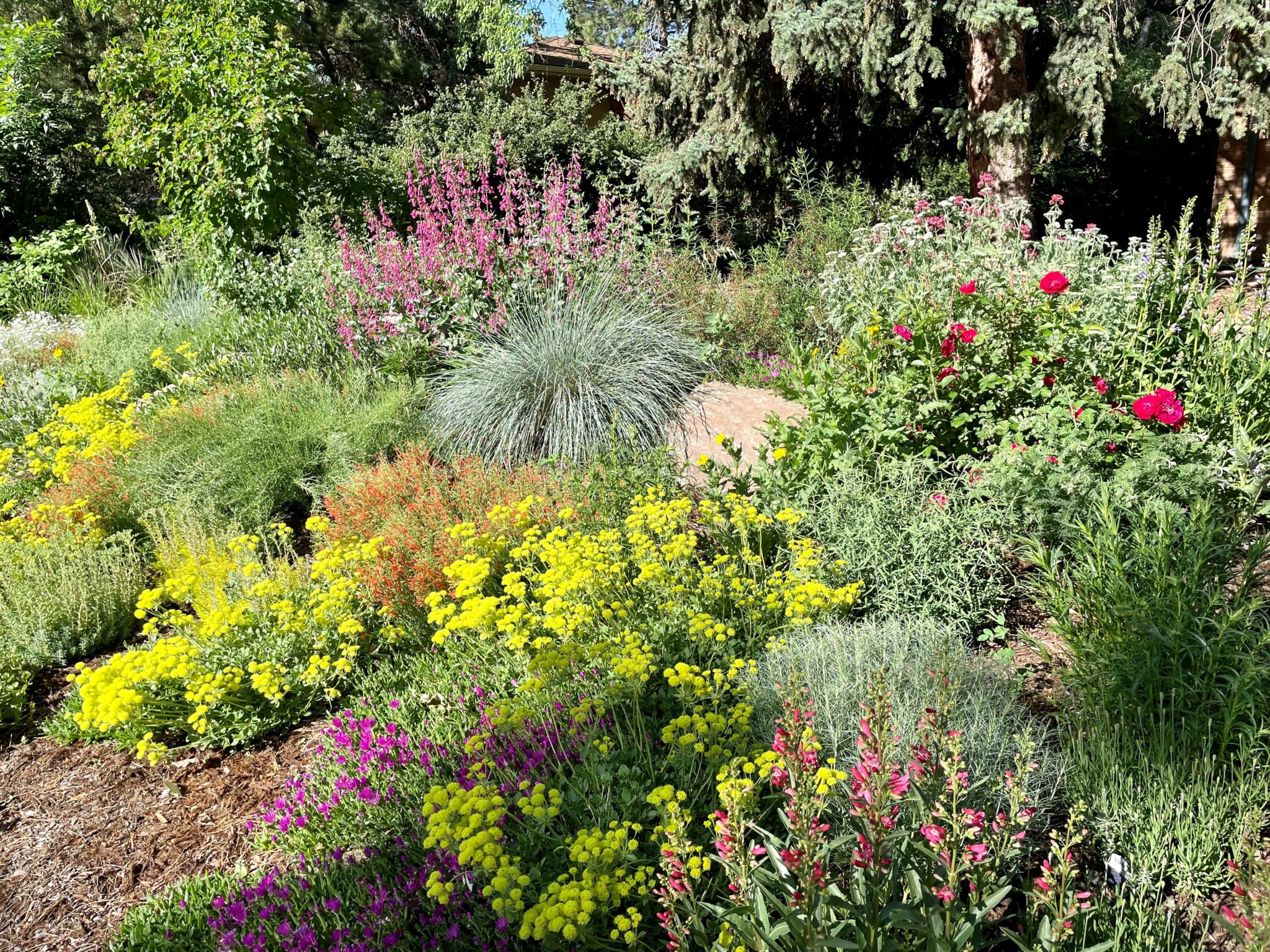
A well-designed perennial garden can provide many years of beauty and enjoyment. Careful selection of plant materials and thoughtful planning can result in a full season of color. A thoughtful design can help you achieve your garden goals including water efficiency, pollinator attraction, family functionality and beauty.
Journaling
Chances are you’ve thought about a new perennial garden before you’ve reached the actual design task. Utilize a journal, phone notes, photos etc. to capture your ideas, ideals and inspiration. These will be helpful references as you get deep in your design process.
Determine Goals and Aesthetics
What do you want to accomplish with your space? Examples of garden goals may include, but are not limited to:
- Water efficiency through Coloradoscaping
- Attract bees, butterflies and/or other pollinators
- Attract birds, become an Audubon garden!
- Ease of Maintenance
- Cut flower garden
- Reduce turf grass
Site Selection
Determine your desired garden location and sit in your space! Things to observe and document which will help with the practice of Right Plant, Right Place.
- Sun Exposure Sun (6+ hours of sun), part sun (4-6 hours of sun), shade (less than 4 hours of sun)
- Available Water
- Walkways, Driveways, Structures, Fences, other Obstructions
- Slopes
- Existing Anchor Plants (trees and shrubs)
- Desired objects to highlight, desired objects to hide
Measure your garden space and create a scale drawing including the above that can be copied for various drafts of your plan.
Build the Bones
Perennial gardens may be best designed with some solid anchors which may include ornamental trees, shrubs, hardscaping (rocks, pathways, etc.), garden art (fountains, statuary, pottery, benches, etc). Use a layered approach with trees in the background, shrubs in the middle and perennials in the foreground and mixed in. The garden bones provide winter interest as well as a foundation.
Plant Selection
Visit your garden center, public gardens, walk the neighborhood, find what you like in the landscape which match your garden goals. Consider color, texture, height and bloom time. Re visit your journaling as well as the concept of Right Plant, Right Place (see Perennial Gardening) which will ensure you’re making the right choice for size, water use, sun exposure, wind, heat zone, soil type, slope and wildlife.
Design Principles
You want your design to appear intentional, harmonious and visually appealing. The following are some key design principles to keep in mind:
- Odd Numbers: Instead of using one of each plant, use 3, 5 or 7 in a grouping. This creates a very intentional look.
- Repetition: Placing the same plants or colors multiple times within the garden creates cohesion in the design. The groupings may be placed at different depths (front vs. back) within the garden to create a natural look. It is often better to use more groups of fewer varieties than a large collection of many different types.
- Seasonal Succession: Bloom time! Always try to have something blooming so pay attention to spring, early summer, mid-summer and late summer bloom times. Very few perennials bloom continuously throughout the season. If continuous color is a priority for you, consider supplementing with annual plants.
- Color: Choose a palette that has variety and contrast. Use a color wheel to find what is pleasing to you.
- Line: Straight lines are formal and controlled, a bold curved line is soft and restful.
- Texture: Don’t forget about foliage and different textures. Wispy foliage or grass adjacent to a large leafed plant creates interest.
Put it on Paper
Now is the time to use your scale drawing. Map out what you’ve chosen. Do not disregard spacing, a perennial in a 4 ½ inch container will really grow to be 2 feet wide if that’s what the plant tag tells you. Your scaled drawing is going to be a bird’s eye view of the garden. Use circles to represent your chosen plants at the size of maturity. Make changes as you want and use the drawing as your guide when purchasing and planting. Other design drawing methods exist using photos and apps. Research as you like and use what is most comfortable. Happy designing, happy gardening!
