
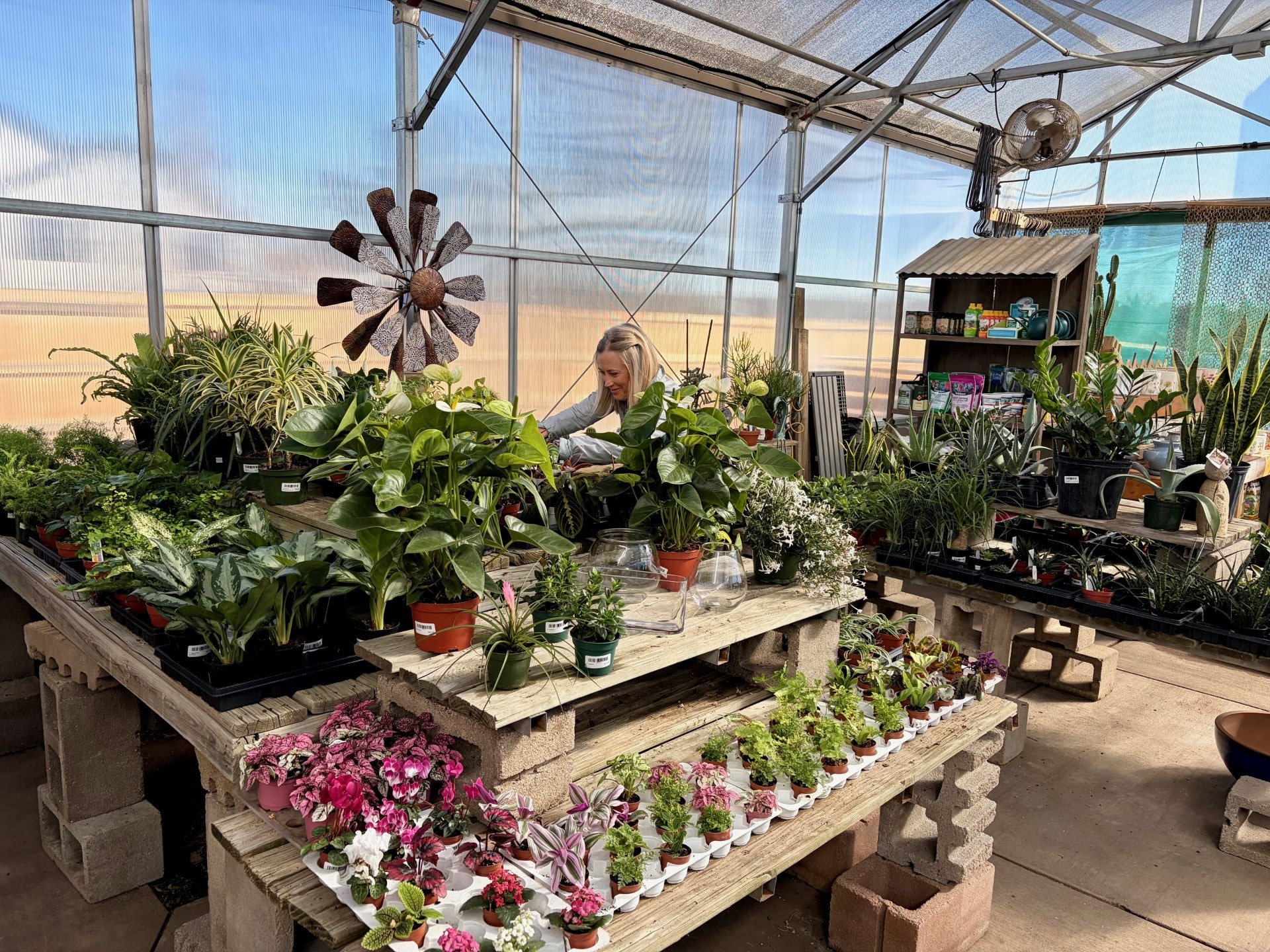
The “secret” to success with taking care of house plants is to create the same ideal conditions as they would enjoy in their native habitat.
Indoor Plant Lighting
Wondering what plant to put where? Here’s an indoor plant lighting guide to four categories of light exposure for house plants.
Sunny (direct sun) location?
- Within 2 feet of a south- or southwest-facing window.
- Windowsills flooded with sunlight.
- Succulents, Cactus, Ficus, Croton, Yucca
Bright (indirect sun) location?
- Within 4-5 feet of an east- or west-facing window.
- 3-5 feet from a window that faces south or southwest.
- Any place where the sun shines into a room with light colored walls for several hours.
- Schefflera, Aralia, Norfolk Pine, Cordyline, Dieffenbachia, Dracaena marg., Ferns, Ivy, Palms
Partially shaded (low light) location?
- An east-facing window where the morning sun shines into the room for only a few hours.
- At least 3-5 feet away from a window that faces south or southwest.
- Directly in front of a north-facing window gives a plant low-to-medium light intensity.
- Dracaena mass., Pothos, Spathiphyllum, Boston fern
Shady location?
- More than 6 feet away from a south- or southwest-facing window.
- Hallways, staircases, and corners of rooms.
- Sansevieria, Aglaonema, Philodendron
Watering
Poke your finger in the soil up to the first knuckle — it’s the surefire way to know if your plant needs water. Does the soil feel damp? Don’t water. Does the soil feel dry? Water.
- Use water at room temperature (68° F/20° C).
- Water thoroughly, then allow the soil to dry out a bit before watering again.
- Don’t over-water — it’s the #1 reason house plants die.
Fertilizer
While light gives plants the energy they require, house plant fertilizer provides the nutrients they need to grow healthy and strong.
- Good potting mixes contain some nutrients to feed a repotted plant for several weeks.
- Use house plant fertilizer as recommended on the label. In low light conditions, use half that amount.
- Fertilizer is not a cure-all for an unhealthy plant. Never feed a plant that’s suffering from root damage, disease or insects.
Propagation
- Sometimes the plant becomes overgrown and needs to be cut back, or you want to ‘separate’ the plant and make a new one. Propagating is very simple.
- Cut at the node and use a rooting hormone. Succulents need to dry out and will start new roots on their own. When roots emerge, you can replant them in soil. “Cuttings’ such as Philodendrons or Pothos can be put in water until new roots emerge. When they do you can use a rooting hormone, then plant in good potting soil.
Pinching
- Using your thumb and forefinger to remove a tip of a stem is known as pinchinga plant.
- Pinching off growing tips will keep a fast-growing vine compact or help to maintain a plant’s bushy shape. When a young stem tip is pinched off, the plant will branch out and become more bushy and fuller.
- Always pinch above a node— the growing point where a leaf is attached. Cuts made here usually force branching below the cut.
- If a vine can’t be easily pinched off with your fingernail, use sharp pruners to avoid tearing a stem.
Re-Potting
- The new pot should be no more than 2 inches wider at the rim — or 2 inches deeper — than the old pot. A pot that’s much larger gives the roots too much space to grow into. The top of the plant won’t grow until its roots begin to fill the container.
- A pot that is too large will hold too much water and can cause root rot. And while I’m on the subject — be sure to choose a container that has drainage holes to allow excess water to escape.
Basically, potting medium offers three things that a plant needs:
- Support (to keep the plant from falling over)
- It stores water and nutrients for the plant’s roots, and still provides good drainage so that the plant doesn’t get waterlogged
- Provides air circulation so that the roots can get oxygen
Most Common Indoor Plant Pests & Control
Fungus Gnats
- Annoying flying pest that does not affect plants unless very high populations exist
- Lay eggs in soil, hatch into small worms, feed on organic matter, emerge as adult flies
- Allow soil to dry out – don’t keep too wet
- Treat soil with systemic plant granules
Spider mites
- Very small sap sucking bugs that lay eggs under the leaves
- Find on underside of leaves under warm dry conditions
- Watch for “bronzing” of leaves for evidence of infestation – severe by that time
- Not an insect so traditional insecticides don’t work – keep up humidity
- Wash off with a blast of water in shower or outside
- Spray plant with horticultural oil to suffocate bugs & eggs
Mealy bugs
- Crawling insect that forms white cottony masses on leaves, stems or crevasses
- Cottony mass is for protection
- Lays eggs that hatch and crawl to new spot to infest
- Swab off cottony masses with Q tip dipped in rubbing alcohol
- Spray plant with horticultural oil to suffocate bugs & eggs
- Spray plant, especially cottony masses with Eight or Triple Action
- Treat soil with systemic plant granules
- Likes plants with smooth, hard, shiny leaves
Scale
- Crawling insect that forms a hard-exterior shell on leaves, stems or crevasses
- Shell or sale is for protection
- Lays eggs that hatch and crawl to new spot to infest
- Swab off cottony masses with Q tip dipped in rubbing alcohol
- Spray plant with horticultural oil to suffocate bugs & eggs
- Spray plant, especially cottony masses with Eight or Triple Action
- Treat soil with systemic plant granules
- Especially likes plants with smooth, hard, shiny leaves
